
UPDATED FOR 2025
Types of Commercial Roof Systems: A Complete Guide
Expert guide to commercial roof systems and their components. County Roofing Systems explains deck, insulation, membrane layers, and more.
Key Takeaways:
- Commercial roofs function as integrated systems where structural deck, vapor barriers, insulation, cover boards, membranes, flashing, and drainage must work together—premium membranes over inadequate insulation won’t perform well
- System integration matters more than individual components: Manufacturer-tested assemblies ensure compatibility, simplify warranties (single-source responsibility), and typically outperform mix-and-match approaches by 20-30% in longevity
- Attachment methods (fully adhered, mechanically attached, ballasted) impact wind resistance, installation speed, and cost—fully adhered offers best wind uplift, mechanical is fastest/most common, ballasted is simplest but requires structural capacity for 10-12 lbs/sq ft stone
- Proper insulation (polyiso at R-6.5/inch, EPS at R-4/inch) can cut energy bills by 30%+, while tapered systems eliminate ponding water that shortens membrane life—worth the 15-20% premium over flat insulation
- Flashing failures cause most leaks (not membrane failures): HVAC penetrations, drains, and parapet walls require proper base/counter flashing, and drainage must remove water within 48 hours to prevent membrane degradation and structural stress
Your commercial roof isn’t just a membrane keeping water out.
It’s an engineered system where multiple layers work together to provide waterproofing, insulation, structural support, and drainage.
The truth is, most building owners don’t understand how these components function as a complete system.
That includes:
Structural decks that support everything above
Vapor barriers that control moisture
Insulation that reduces energy bills
Cover boards that protect and stabilize
Waterproofing membranes that keep water out
Flashing that seals penetrations
Drainage systems that remove water
Below, we’ll break down commercial roofing systems layer by layer—how each component works and why proper integration matters for long-term performance.
What is a Commercial Roof System?
Let’s start with the basics.
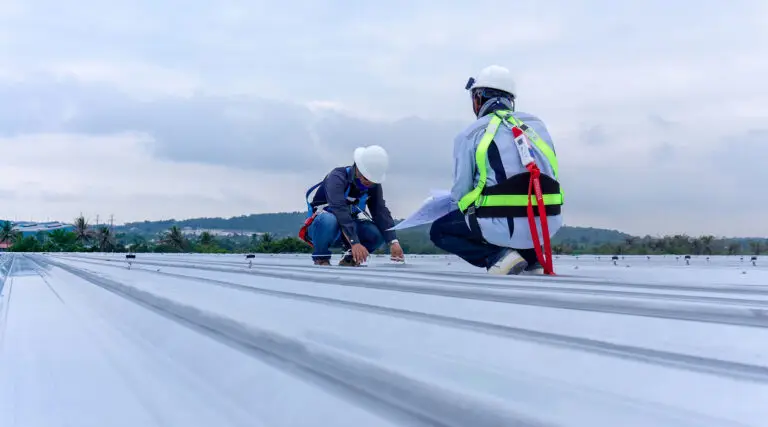
A roof system refers to the complete assembly of materials and components that make up your commercial roof—from the structural deck to the top waterproofing membrane.
Each layer serves a specific purpose. And here’s the important part: they must be properly integrated with each other.
The system approach to roofing means that material selection, installation methods, and maintenance procedures all consider how components interact. A high-quality membrane installed over inadequate insulation won’t perform as well as a properly designed complete system.
Types of commercial roof systems are typically categorized by their attachment method (fully adhered, mechanically attached, or ballasted) and their waterproofing approach (single-ply, multi-ply, or coating-based).
FINANCE YOUR HOME IMPROVEMENT PROJECT TODAY
0% Financing, Quick and Easy Approval
With nearly four decades serving homeowners under our belt, we know what’s needed to make your roofing project a success.
After completing your roof inspection, if repairs or updates are recommended, we’ll do everything we can to make affording your roof repair or replacement quick and easy.
When you work with County Roofing, you get only the best. As little as 0% interest on approval for 5 years, quick approval, easy pay, and all backed by the best guarantees in the industry.
The Structural Deck: Foundation of the System
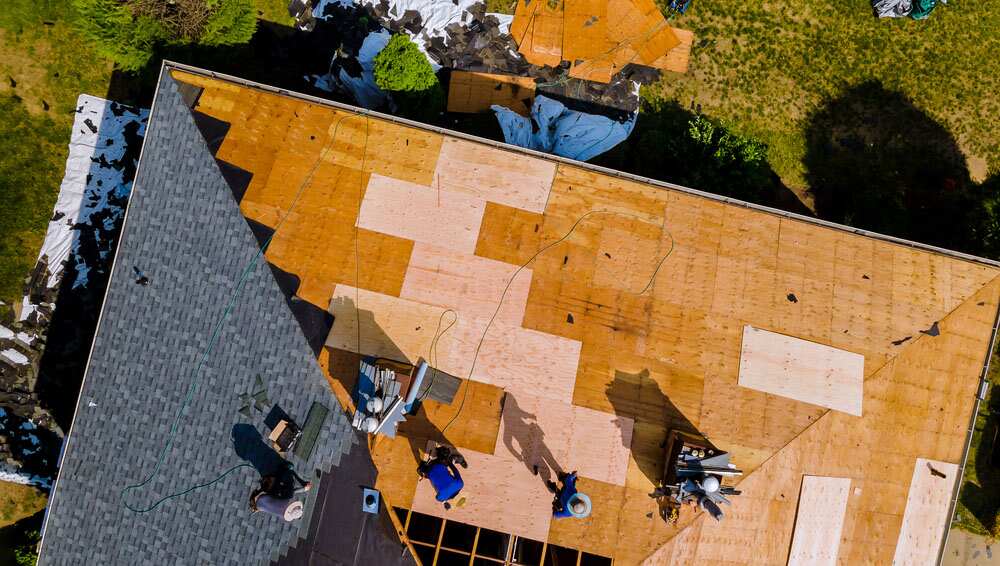
The roof deck forms the structural foundation that supports all other roofing materials.
It must withstand the weight of the roof system, equipment, maintenance personnel, and environmental loads like snow accumulation.
Commercial roof decks are typically constructed from steel, concrete, or wood.
Steel Decks
Steel decks are most common in new construction due to their strength, fire resistance, and long spans between supports.
The corrugated or ribbed profile provides structural rigidity while minimizing weight. For many commercial buildings, steel decks offer the best balance of performance and cost.
Steel decks accept mechanical fasteners easily, which makes them compatible with mechanically attached membrane systems. The flat areas between ribs can accommodate adhesive for fully adhered systems.
Concrete Decks
Concrete decks offer exceptional strength and fire resistance.
They’re common in precast concrete construction. The solid, flat surface simplifies roofing installation—no corrugations to work around, just a smooth substrate for whatever roofing system you choose.
Concrete handles heavy loads without additional reinforcement. That makes it ideal for commercial buildings with rooftop equipment or green roof installations that add substantial weight.
The limitation is weight. Concrete decks are heavy, which increases structural costs for the building frame.
Wood Decks
Wood decks, usually plywood or oriented strand board (OSB), appear in older buildings or wood-framed construction.
They accept fasteners easily, which makes them ideal for mechanically attached membrane systems. The solid surface works well with fully adhered systems too.
However, wood requires proper ventilation and moisture control to prevent rot. For Long Island’s humid coastal climate, that means careful vapor barrier design and adequate ventilation.
The deck condition determines what types of commercial roofing systems can be installed. Deteriorated decks must be replaced or reinforced before installing a new roof. Decks that can’t accept fasteners require fully adhered or ballasted systems instead of mechanical attachment.
Vapor Barriers: Controlling Moisture
Vapor barriers control moisture movement from inside the building into the roof system.
Here’s why that matters: Warm, moist air from inside your building naturally wants to move toward the cooler exterior. If that moisture gets into your insulation, it reduces thermal performance and can cause condensation problems.
Vapor barriers are typically installed directly over the roof deck, below the insulation. They prevent interior moisture from reaching the insulation layer where it could condense and cause problems.
The material is usually a sheet membrane or coating that creates a barrier to water vapor transmission. Installation must be continuous with sealed seams—any gaps defeat the purpose.
For heated buildings in cold climates (like Long Island winters), vapor barriers are essential. They prevent warm interior moisture from condensing within the roof system.
The trade-off is that vapor barriers also trap any moisture that does get into the system. That’s why proper installation and maintaining a continuous barrier matter so much.
Insulation: Thermal Performance and Energy Efficiency
Insulation is where you reduce energy bills.
Proper insulation can cut heating and cooling costs by 30% or more compared to poorly insulated commercial roofs. For Long Island commercial properties, that translates to thousands of dollars annually.
Polyisocyanurate (Polyiso)
Polyiso is the most common insulation in commercial roofing systems.
It provides about R-6.5 per inch—the highest R-value per inch of any rigid foam insulation. That means you get maximum thermal performance with minimum thickness.
The material is lightweight and cost effective. It’s compatible with all types of commercial roofing materials and attachment methods.
The limitation is cold-weather performance. Polyiso loses R-value as temperatures drop. In Long Island winters, the effective R-value can drop to R-5 or less per inch.
Expanded Polystyrene (EPS)
EPS maintains consistent R-value across temperature ranges—about R-4 per inch regardless of conditions.
That stable performance makes it a good choice for cold climates. The material is also more affordable than polyiso, which helps control project costs.
The trade-off is thickness. You need more EPS than polyiso to achieve the same R-value.
Tapered Insulation
Tapered insulation creates positive water drainage and provides a better R-value for the building.
Instead of flat insulation boards, tapered systems use boards of varying thickness that create slope toward drains. This eliminates standing water on flat roofing surfaces.
The system typically starts with 2-4 inches of insulation at the drains and increases gradually toward the center of the roof. That creates the 1/4 inch per foot minimum slope needed for proper drainage.
Tapered insulation costs more than flat boards but prevents the ponding water that shortens membrane life.
Mineral Wool
Mineral wool provides fire resistance with good thermal performance.
The material is made from molten rock or slag spun into fibers. It won’t burn and can actually help contain fires—valuable for industrial buildings or facilities where fire resistance is a priority.
R-value is about R-4 per inch. The material handles moisture better than foam insulation, which prevents degradation in high-humidity environments.


LIFETIME MATERIAL, LIFETIME WORKMANSHIP WARRANTY
Get Industry-Leading Protection
CertainTeed’s lifetime-limited transferable warranty is a true industry standout. Whereas other manufacturers only warrant against defects that cause leaks, CertainTeed protects your investment against all manufacturing defects, including aesthetic defects.
County Roofing Systems can offer you the longest warranties available because we’re a CertainTeed SELECT ShingleMaster, a certification only 1% of contractors qualify for.
We have over 35 years of experience living up to CertainTeed’s tough standards. That means CertainTeed trusts our home improvement work enough to stand behind it with their best guarantees.
To learn more about the industry-leading LIFETIME material, LIFETIME workmanship warranty, click the button below to call us today:
Cover Boards: Protection and Stability
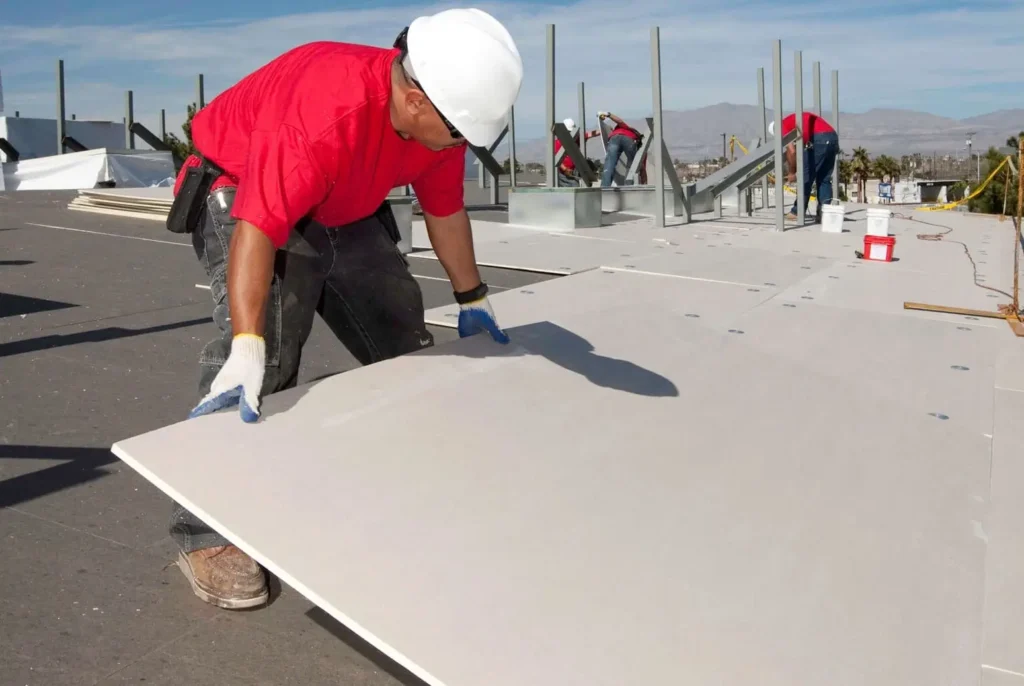
Cover boards protect insulation and create stable substrates for membrane attachment.
They’re particularly important with softer insulation that can be damaged by heavy foot traffic or thermal expansion/contraction of the membrane.
Gypsum Cover Boards
Gypsum provides a cost-effective choice for cover boards.
The material is rigid, fire-resistant, and creates a smooth surface for membrane installation. It protects the insulation from physical damage and provides a stable base for the waterproofing layer.
The limitation is moisture sensitivity. Gypsum degrades when wet, which makes proper installation critical.
High-Density Polyiso
High-density polyiso serves double-duty as insulation and cover board.
It provides additional R-value while protecting softer insulation below. The denser material resists compression and creates a stable substrate for the roof system.
Cement Fiber Boards
Cement fiber provides the most durable cover board option.
The material is extremely impact-resistant and fire-resistant. It handles heavy foot traffic without damage and provides excellent protection for the insulation layer.
The trade-off is weight. Cement fiber boards are heavier than other options, which requires adequate structural capacity in your deck.
Waterproofing Membranes: Primary Weather Barrier
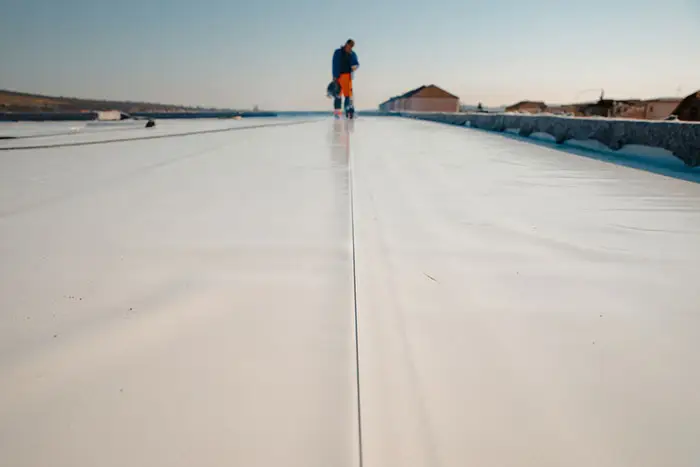
The waterproofing membrane is your primary defense against weather.
This is the layer most people think of when they think “roof.” But as we’ve covered, it’s just one component of the complete system.
Single-Ply Membranes
Single-ply roofs use factory-manufactured sheets that create a continuous waterproof barrier.
TPO roofing, PVC roofing, and EPDM roofing are the three main types. Each offers different advantages in terms of energy efficiency, chemical resistance, and cost.
Single-ply roofing systems are lightweight, fire-resistant, and provide a high wind rating when properly installed.
Multi-Ply Systems
Built-up roof (BUR) systems and modified bitumen systems use multiple layers of waterproofing.
BUR systems consist of alternating layers of bitumen and roofing felts—typically 3-5 layers. The redundancy means that if one layer develops a problem, you have backup protection.
Modified bitumen roofing systems can be installed using hot tar, but the most popular installation methods are without the hot tar. The type of modifier used in modified bitumen systems may determine the method of sheet installation.
Liquid-Applied Systems
Liquid applied membrane roofing requires rigorous preparation of the substrate, which must be dry and dust-free with patched cracks.
These systems involve applying liquid coatings that cure into seamless membranes. Roof coatings can extend the life of existing roofs and are a cost-effective solution for waterproofing.
Liquid-applied systems work well for retrofit projects where you’re restoring an existing roof rather than complete tear off and replacement.
Attachment Methods: Securing the System
How you attach the membrane to the deck matters as much as which membrane you choose.
Fully Adhered Systems
Fully adhered systems use adhesive to bond the membrane directly to the substrate below.
This creates a monolithic assembly where the membrane, insulation, and deck work as one unit. Wind uplift resistance is excellent because there’s no opportunity for wind to get under the membrane.
The limitation is installation complexity. The substrate must be clean, dry, and properly prepared. Any contamination prevents proper adhesion.
Mechanically Attached Systems
Mechanically attached systems use fasteners and plates to secure the membrane.
Fasteners penetrate through the membrane and insulation into the deck below. Plates distribute the load and prevent fastener pull-through.
This method is faster than full adhesion and works even when substrate conditions aren’t perfect. It’s the most common attachment method for commercial roofing systems.
The trade-off is that fasteners create potential leak points. Proper installation and quality fasteners are critical.
Ballasted Systems
Ballasted systems use stone or pavers to hold the membrane in place.
The membrane is laid loose over the insulation. Stone (typically 10-12 pounds per square foot) or concrete pavers hold it down through weight alone.
This is the fastest installation method. There’s no adhesive cure time and no fastener penetrations through the membrane.
The limitation is weight. Your deck must support the additional load. Building codes may restrict ballasted systems in high wind areas.
Flashing: Sealing Penetrations and Edges
Flashing is where most roof leaks start.
Penetrations for HVAC units, exhaust vents, and roof drains create interruptions in the waterproof membrane. Edges and transitions need special treatment too.
Proper flashing creates watertight seals at these vulnerable points. The flashing material must be compatible with your membrane and installed according to manufacturer specifications.
Base flashing rises vertically from the roof surface. Counter flashing covers the top edge of base flashing and sheds water away from the penetration.
For Long Island commercial roofs exposed to high winds, flashing details are especially critical. Wind-driven rain can penetrate flashing that would be fine in calmer climates.
Many commercial buildings experience leaks at flashing details long before the membrane itself fails. That’s why proper flashing installation and regular inspections matter so much.
Drainage Systems: Removing Water
Water removal is critical for commercial roof longevity.
Standing water accelerates membrane aging, increases likelihood of leaks, and adds weight that stresses the structure. Your drainage system must remove water within 48 hours to prevent these problems.
Internal Drains
Internal drains are the most common drainage solution for commercial buildings.
They’re located at low points in the roof (usually in the middle of the roof area). Water flows to drains through internal piping that runs through the building to the ground.
Drains must be properly sized for the roof area. Undersized drains can’t handle heavy rain, which leads to ponding and potential overflow.
Strainers prevent debris from clogging the drain. Regular maintenance to clear these strainers is essential.
Scuppers
Scuppers are openings through the parapet wall that allow water to drain off the roof edge.
They work by gravity—when water reaches the scupper level, it flows through the opening and drains down the building exterior.
Scuppers provide backup drainage for internal drain systems. Even if drains clog, scuppers prevent water from exceeding safe levels on the roof.
The limitation is that scuppers discharge water near the building. You need proper site drainage to handle this water.
Gutters and Downspouts
Gutters collect water from roof edges and direct it to downspouts.
For commercial buildings with sloped roofs or metal roofing systems, gutters are the primary drainage method. They prevent water from cascading off roof edges and causing erosion or foundation problems.
Gutters require regular maintenance. Debris accumulation reduces capacity and can cause overflow during heavy rain.
For Long Island buildings surrounded by trees, gutter cleaning 2-3 times per year is typically necessary.
System Integration: Why It All Matters
Here’s the thing about roof systems: the whole is greater than the sum of its parts.
A premium membrane over inadequate insulation won’t perform well. Excellent insulation with improper flashing details will leak. Perfect materials with wrong attachment methods will fail prematurely.
That’s why the right roofing system approach matters. Manufacturer-tested assemblies ensure all components work together properly.
You also get simplified warranties. Single-source responsibility means one manufacturer stands behind the complete system. If something goes wrong, you’re not dealing with finger-pointing between membrane, insulation, and deck manufacturers.
Commercial roofing priorities in 2026 include longevity, energy efficiency, and adaptation to building use and climate. Systems that integrate these priorities from the deck up deliver better long-term performance than component-by-component approaches.
Smart Roof Monitoring
Modern commercial roof systems can include advanced monitoring technology.
Smart roof monitoring integrates moisture sensors and AI-powered leak detection for proactive maintenance.
Sensors embedded in the roof system detect moisture intrusion before it causes visible damage. You can identify and repair small problems before they become expensive failures.
For critical facilities that can’t afford unexpected roof failure, smart monitoring provides valuable early warning.
Working with County Roofing Systems
At County Roofing Systems, we don’t just install membranes—we design and install complete roof systems.
Our 35+ years of experience means we understand how all the layers work together. We’re GAF Master Elite, CertainTeed SELECT ShingleMaster, and Owens Corning Platinum Preferred certified.
We can evaluate your existing roof, recommend appropriate systems for your building and budget, and install everything according to manufacturer specifications.
That means you get enhanced warranty coverage and the long-term performance that comes from properly integrated systems.
For a free inspection and system consultation, call (631) 400-ROOF, that’s (631) 400-7663.
Design the Right Roof System for Your Commercial Building
At County Roofing Systems, we don’t just replace membranes—we design and install complete roof systems engineered to work together.
Nearly four decades of experience has taught us that system integration matters more than any single component. We’ve seen expensive membranes fail because insulation was inadequate, and budget materials perform exceptionally because the complete system was designed correctly.
Our GAF Master Elite, CertainTeed SELECT ShingleMaster, and Owens Corning Platinum Preferred certifications mean we follow manufacturer-tested assemblies that ensure every layer works together properly.
Ready to discuss a complete roof system for your building? Contact us for a free inspection and system evaluation. We’ll review:
Your existing roof system condition (deck, insulation, membrane, drainage)
System options appropriate for your building type and use
Energy efficiency improvements that reduce operating costs
Attachment methods suited for Long Island’s wind exposure
Proper integration of flashing, drainage, and penetrations
Complete system warranties versus component-only coverage
We’ll explain how each layer contributes to overall performance and help you understand the difference between properly integrated systems and piecemeal approaches that cost more in the long run.
Call County Roofing today at (631) 400-ROOF, that’s (631) 400-7663, for your free system evaluation and proposal.
Fast & Easy Financing with County Roofing
Financing your commercial roofing project has never been easier.
With County Roofing, you can get fast approvals with as low as 0% financing on new roofing projects for up to 15 years, with payments as low as $149:
First Approvals
0% financing
No income check
Up to 15 years
Monthly payments as low as $149
Fill out the form below or give us a call at (631) 400-7663 today to get started:
Call or contact us today
for your free comprehensive roofing estimate.

Call Us Today: (631) 400-7663