UPDATED FOR 2025
How Long Should a Roof Last on Long Island? Understanding Roof Lifespan in New York's Climate
Discover how long roofs last on Long Island. Learn how NY’s climate affects asphalt shingles, flat roofs, and metal roofing lifespans, plus how proper installation extends your roof’s life.
Key Takeaways:
- Asphalt shingles last 19-25+ years on Long Island – Climate-appropriate materials and expert installation are crucial for maximizing lifespan
- Long Island’s climate is harder on roofs than warmer regions – Freeze-thaw cycles, coastal humidity, and nor’easters accelerate aging
- Proper installation can double your roof’s effective lifespan – Poor workmanship is the #1 cause of premature roof failure
- Flat roofs require more maintenance but can last 15-30 years – Material choice and drainage systems critically impact longevity
- Metal roofs offer the longest lifespan at 40-70 years – Higher upfront cost balanced by decades of protection
- Ice dams, salt air, and UV exposure are Long Island-specific challenges – Proper ventilation, coastal-grade materials, and experienced contractors are essential
- Regular maintenance extends any roof’s life by 5-10 years – Annual inspections catch small problems before they become expensive failures
Your roof stands between your family and everything Long Island’s climate can throw at it—scorching summer heat, nor’easters, coastal humidity, freeze-thaw cycles, and the occasional hurricane.
It’s one of your home’s most critical investments, and naturally, you want to know: how long should it last before you need a roof replacement?
The answer isn’t as simple as a single number. Your roof life expectancy depends on the materials you choose, the quality of installation, and how well it stands up to Long Island’s unique weather challenges. A poorly installed premium roof can fail in half the time of a properly installed standard roof.
This guide breaks down exactly how long different roofing types last in Long Island’s climate, what shortens their lifespan, and how proper installation by experienced professionals makes all the difference between a 15-year failure and a 30+ year investment.
You’ll learn when it’s time to replace your aging roof and how to maximize the value of your new roof with the right materials and roof warranty protection.

Why Long Island’s Climate Matters for Your Roof
Before we dive into specific roof types, it’s important to understand why Long Island presents unique challenges that affect how long your roof will last.
The Four Seasons Attack
Long Island experiences dramatic seasonal extremes that few other regions endure:
Summers (90°F+) Roof surface temperatures can reach 150-180°F on dark-colored shingles during July and August heat waves. This intense heat causes asphalt shingles to soften, expanding adhesive seals that then contract when temperatures drop at night. This constant expansion and contraction stresses materials and accelerates aging.
Winters (Below 32°F) Long Island averages 15-20 freeze-thaw cycles per winter. Water that infiltrates tiny cracks during the day expands when it freezes overnight, making those cracks larger. Over 15-20 winters, even minor imperfections become major failures.
Spring & Fall (Nor’easters) Coastal storms bringing heavy rain, high winds (50+ mph gusts), and sometimes snow can strip shingles, damage flashing, and overwhelm drainage systems. These intense weather events test every weak point in your roofing system.
Coastal Humidity and Salt Air
Living near Long Island Sound, the Atlantic Ocean, or even a few miles inland exposes your roof to persistent challenges:
High humidity (often 70-80% or higher near the water) creates ideal conditions for algae, moss, and mold growth that can deteriorate organic materials
Salt air accelerates corrosion of metal components like flashing, fasteners, gutters, and HVAC penetrations
Moisture retention in underlayment and decking can lead to rot, especially with inadequate ventilation
Increased Precipitation
Long Island’s annual precipitation has increased over 10% in recent decades, with more frequent heavy downpours. This means:
Greater stress on drainage systems
More opportunities for water infiltration
Increased risk of ice dams forming in winter
Higher humidity levels affecting attic spaces and roof decking
UV Radiation Exposure
Long Island receives intense summer sunlight that breaks down roofing materials through UV radiation. South-facing roof slopes receive the most exposure and typically show wear 20-30% faster than north-facing sections.
The Bottom Line: Roofs in southwestern states might fail primarily from heat. Roofs in snowy mountain regions face mainly snow loads. Long Island roofs must withstand everything at once, which is why choosing the right materials and ensuring proper installation is absolutely critical.
FINANCE YOUR HOME IMPROVEMENT PROJECT TODAY
0% Financing, Quick and Easy Approval
With nearly four decades serving homeowners under our belt, we know what’s needed to make your roofing project a success.
When you work with County Roofing, you get only the best. As little as 0% interest on approval for 5 years, quick approval, easy pay, and all backed by the best guarantees in the industry.
Asphalt Shingle Roofs: Long Island’s Most Common Choice
Asphalt shingles account for roughly 80% of residential roofs across Nassau and Suffolk Counties. They’re affordable, versatile, and perform well—if you choose the right type and have them installed correctly.
Expected Lifespan in Long Island’s Climate
3-Tab Asphalt Shingles: 15-20 years
These are the economy option—thin, lightweight, and the least expensive. However, in Long Island’s challenging climate, they’re at the lower end of their lifespan range. Manufacturers might advertise 20-25 year warranties, but real-world performance in the Northeast typically delivers 15-18 years before significant deterioration.
Architectural/Dimensional Shingles: 20-25 years
These thicker, multi-layered shingles offer better wind resistance, improved aesthetics, and longer lifespans. In Long Island’s climate with proper installation and maintenance, quality architectural shingles from manufacturers like GAF, CertainTeed, and Owens Corning regularly reach 22-25 years.
Premium/Designer Shingles: 25-30 years
High-end shingles with enhanced UV protection, impact resistance, and superior granule adhesion can push close to 30 years on Long Island—especially when installed by certified contractors who qualify you for enhanced warranties.
What Shortens Asphalt Shingle Life on Long Island
Poor Ventilation Inadequate attic ventilation is the silent killer of Long Island roofs. Without proper air flow:
Summer heat builds up in attics, cooking shingles from below and reaching 150-160°F
Winter moisture can’t escape, leading to condensation, mold, and wood rot
Ice dams form more readily as warm attic air melts snow, which then refreezes at roof edges
Proper ventilation—combining intake vents at soffits with exhaust vents at the ridge—can extend shingle life by 5-7 years.
Ice Dams When warm attic air melts snow on your roof, the water runs down to the cold eaves and refreezes, creating a dam. Water backs up under shingles, causing:
Leaks into walls and ceilings
Damaged underlayment and decking
Loosened shingles and flashing
Interior water damage
Poor Installation This is the #1 cause of premature shingle failure. Common installation errors include:
✗ Incorrect nail placement (too high, too low, over-driven, or under-driven)
✗ Insufficient starter strip at eaves and rakes
✗ Improper flashing around chimneys, skylights, and penetrations
✗ Inadequate underlayment or ice & water shield
✗ Failure to follow manufacturer specifications (voids warranties)
A roof installed by an inexperienced crew can fail at 10-12 years instead of 20-25 years—and you won’t realize the installation was faulty until expensive damage appears.
Algae and Moss Growth Long Island’s humid climate creates ideal conditions for black algae streaks (gloeocapsa magma) and moss growth. While primarily cosmetic at first, these organisms:
Retain moisture against shingles, accelerating deterioration
Lift shingle edges as moss roots penetrate
Reduce reflectivity, increasing heat absorption
Indicate potential moisture problems in underlying materials
Storm Damage Nor’easters, occasional hurricanes, and severe thunderstorms with straight-line winds test your roof’s wind resistance. Wind can:
Lift and tear off shingles, especially if they’re aging or poorly installed
Drive rain under shingles that would normally shed water
Launch debris (branches, patio furniture, etc.) that punctures or cracks shingles
Create missing shingles that expose underlayment and lead to roof leaks

How to Maximize Asphalt Shingle Lifespan
Choose Climate-Appropriate Shingles For Long Island, look for roofing shingles with:
✓ Algae-resistant shingles with copper granules
✓ High wind ratings (110+ mph for coastal areas)
✓ Class 4 impact resistance for hail protection
✓ “Cool roof” technology to reflect heat (lighter colors)
Ensure Proper Installation
✓ Hire GAF Master Elite, CertainTeed SELECT ShingleMaster, or Owens Corning Platinum Preferred certified contractors
✓ Verify proper underlayment (synthetic preferred over felt)
✓ Require ice & water shield at eaves (minimum 3 feet, preferably to 6 feet from edge)
✓ Insist on proper ventilation with 1 square foot of net free vent area per 150 square feet of attic
✓ Get written confirmation that installation follows manufacturer specs
Maintain Regularly
✓ Annual inspections (spring and fall)
✓ Keep gutters clean to prevent ice dams and water backup
✓ Trim overhanging branches to reduce debris and shade-induced moss
✓ Address small repairs immediately before they become big problems
✓ Ensure attic ventilation remains unobstructed
Flat Roofs: Commercial and Residential Low-Slope Systems
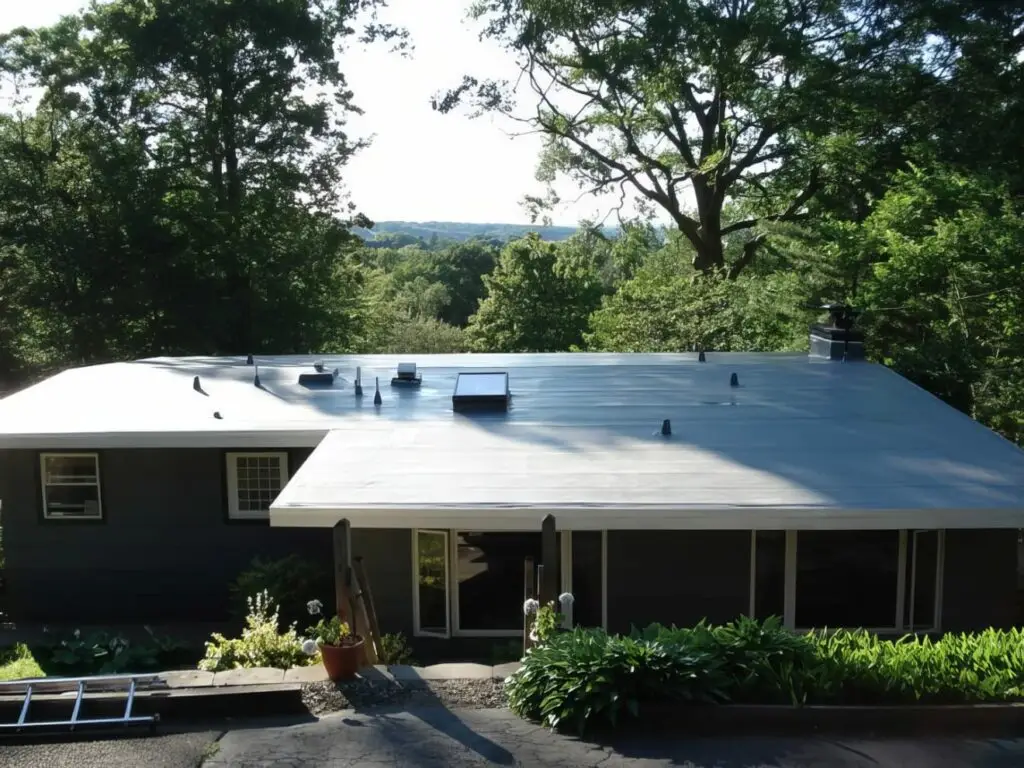
Flat roofs are common on Long Island for garage roofs, additions, porches, and commercial buildings.
They require different materials and maintenance approaches than sloped roofs, and understanding their roof life expectancy helps you plan for long-term maintenance and eventual replacement.
Expected Lifespan in Long Island’s Climate
EPDM (Rubber Membrane): 20-30 years
EPDM (ethylene propylene diene monomer) is a synthetic rubber membrane that’s been used since the 1960s. It’s:
Durable in temperature extremes (handles Long Island’s range well)
Resistant to UV radiation
Relatively affordable
Easy to repair
With proper installation and maintenance, EPDM roofs on Long Island typically deliver 20-25 years, with premium installations reaching 30 years.
TPO (Thermoplastic Polyolefin): 20-25 years
TPO is a single-ply membrane that’s surged in popularity since the 1990s. It offers:
Excellent UV resistance
Heat-welded seams stronger than the membrane itself
White surface that reflects heat (energy efficient)
Good flexibility in cold weather
TPO roofs in Long Island’s climate typically last 20-23 years when properly installed.
PVC (Polyvinyl Chloride): 25-30 years
PVC is the premium single-ply option:
Superior chemical resistance (important near coastal salt air)
Excellent UV resistance
Heat-welded seams
Fire resistant
Available in various colors
PVC roofs can reach 28-30 years on Long Island with proper installation and maintenance.
Modified Bitumen: 15-20 years
Modified bitumen is an asphalt-based system enhanced with rubber or plastic modifiers:
Good flexibility in temperature swings
Resistant to punctures
Multiple installation methods (torch-down, cold-applied, self-adhering)
Cost-effective
In Long Island’s climate, modified bitumen systems typically last 15-18 years, with premium installations reaching 20 years.
THE BEST GUARANTEE IN THE INDUSTRY
50-Year Material, 25-Year Labor Guarantee
We’ve met the toughest requirements in the residential roofing industry- and we use only the best materials.
That’s why we stand behind our work with the best guarantee in the industry– including warranties only 2% of roofing companies can offer.
Your house deserves the best roofing warranty on the market. Give us a call today and get a brand new roof with a 50-year material, 25-year labor warranty from the best roofing contractor in Long Island and New York.
What Shortens Flat Roof Life on Long Island
Ponding Water Any water that remains on a flat roof for more than 48 hours after rain is “ponding.” This:
Accelerates membrane deterioration through constant moisture exposure
Increases weight loads (water weighs 8.3 lbs per gallon)
Creates opportunities for algae and moss growth
Indicates poor drainage or structural settling
Flat roofs should have a minimum 1/4 inch per foot slope to ensure drainage.
Freeze-Thaw Cycles Water that infiltrates tiny seam gaps or membrane cracks expands when frozen, enlarging those openings. Over 15-20 freeze-thaw cycles per winter, minor installation imperfections become major leaks.
UV Degradation Constant sun exposure (especially on black EPDM membranes) breaks down materials over time. Surface temperatures can reach 160-180°F on summer days, causing:
Membrane brittleness
Seam separation
Accelerated aging of the entire system
Poor Installation Common flat roof installation errors include:
✗ Inadequate seam welding or adhesive application
✗ Insufficient membrane overlap at seams
✗ Poor flashing details around penetrations (HVAC, vents, drains)
✗ Inadequate slope for drainage
✗ Using incorrect adhesives for climate conditions
Foot Traffic Many flat roofs accommodate HVAC equipment or rooftop access. Excessive foot traffic causes:
Membrane punctures
Seam stress
Accelerated wear at high-traffic areas
How to Maximize Flat Roof Lifespan
Ensure Proper Drainage
✓ Verify minimum 1/4 inch per foot slope
✓ Install adequate drains and scuppers
✓ Keep drains clear of debris
✓ Address ponding issues immediately
Choose the Right Membrane
✓ EPDM for budget-conscious projects
✓ TPO for energy efficiency (reflective white surface)
✓ PVC for coastal areas (superior chemical resistance)
✓ Modified bitumen for retrofit situations
Professional Installation is Critical
✓ Hire experienced commercial roofing contractors
✓ Ensure proper seam welding/adhesion
✓ Verify correct flashing installation
✓ Confirm adequate insulation and drainage design
Maintain Aggressively
✓ Inspect twice yearly (spring and fall)
✓ Clear drains and remove debris monthly
✓ Address seam issues immediately
✓ Apply roof coatings every 10-12 years to extend life
✓ Limit foot traffic to designated walkways
Metal Roofs: The Longest-Lasting Option
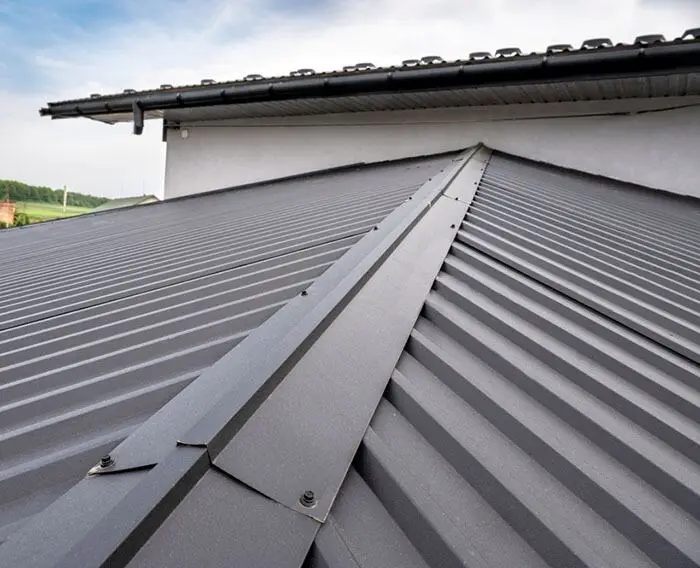
Metal roofing has grown in popularity on Long Island for both residential and commercial properties. It’s the most durable option available.
Expected Lifespan in Long Island’s Climate
Standing Seam Steel: 40-50 years
Galvanized or galvalume steel with standing seam profiles offers:
Excellent wind resistance (can withstand 140+ mph winds)
Minimal maintenance requirements
No issues with freeze-thaw cycles (water sheds immediately)
Fire resistance
With proper installation, steel roofs on Long Island regularly reach 45-50 years.
Aluminum: 40-50 years
Aluminum is lighter than steel and naturally corrosion-resistant:
Ideal for coastal areas (won’t rust from salt air)
Excellent wind and weather resistance
Energy efficient (reflects heat)
Lightweight (doesn’t require structural reinforcement)
Aluminum roofs in Long Island’s coastal environment can reach 45-50 years.
Copper: 60-100+ years
Copper is the ultimate in longevity:
Naturally antimicrobial (resists algae and moss)
Develops protective patina over time
Exceptional durability
Premium aesthetics
Copper roofs can last 70-100+ years on Long Island, making them generational investments.
Stone-Coated Steel: 40-60 years
Stone-coated steel tiles mimic the look of traditional shingles or clay tiles:
Combines steel durability with aesthetic versatility
Excellent impact and wind resistance
More affordable than solid copper
Multiple style options
These systems typically deliver 40-50 years in Long Island’s climate.
What Affects Metal Roof Longevity on Long Island
Fastener and Flashing Quality The weakest points in metal roofs are typically fasteners and flashing, not the metal itself. Use:
✓ Stainless steel or corrosion-resistant fasteners
✓ Hidden fastener systems (standing seam) when possible
✓ Butyl tape and proper underlayment
✓ Compatible metals to avoid galvanic corrosion
Expansion and Contraction Metal expands in heat and contracts in cold. Long Island’s wide temperature swings (often 100°F difference between summer peaks and winter lows) mean:
Fasteners must allow movement
Panels need proper spacing
Clips and fastening systems must accommodate thermal movement
Coastal Corrosion Even “rust-proof” metals can corrode in coastal salt air if:
✗ Protective coatings are compromised
✗ Dissimilar metals contact each other (galvanic corrosion)
✗ Fasteners are low-quality
For coastal Long Island (within 2-3 miles of water), use marine-grade materials and stainless steel fasteners.
Why Metal Roofs Excel on Long Island
Storm Resistance Metal roofs handle nor’easters and hurricanes better than any other material:
Interlocking panels resist wind uplift
Smooth surfaces shed water immediately
No shingles to blow off
Impact-resistant to hail and debris
No Ice Dam Issues Metal’s smooth surface and superior thermal properties mean:
Snow slides off more readily
No granule loss or shingle damage from ice
Heat doesn’t transfer from attic as easily
Ice dams rarely form
Energy Efficiency Metal roofs reflect solar radiation:
Reduces cooling costs by 10-25% in summer
Available in “cool roof” coatings for maximum efficiency
Pays for itself through energy savings over decades
Minimal Maintenance Unlike asphalt or flat roofs:
No periodic replacement needed
No moss/algae treatments
Occasional inspections and fastener checks are sufficient
Typically outlasts the homeowner’s occupancy
Metal Roof Considerations
Higher Upfront Cost Metal roofs cost 2-3 times more than asphalt shingles initially. However, when you factor in:
Longer lifespan (40-50 years vs. 20-25 years)
Lower maintenance costs
Energy savings
Increased home value
The total cost of ownership is often comparable or better than replacing asphalt shingles 2-3 times over the same period.
Noise Rain and hail can be louder on metal roofs. This is mitigated by:
Proper insulation
Solid sheathing (not open framing)
Quality underlayment
Denting Softer metals (aluminum, copper) can dent from severe hail or falling branches. Stone-coated steel offers the best impact resistance.
The Critical Factor: Professional Installation
Here’s the truth every Long Island homeowner needs to understand: the quality of installation matters more than the materials you choose.
A $15,000 premium roof installed by inexperienced workers can fail in 12-15 years. A $10,000 standard roof installed by skilled professionals regularly reaches 25+ years.
Why Installation Quality Matters So Much
Manufacturer Warranties Require Proper Installation Those 25, 30, or 50-year warranties? They’re void if installation doesn’t follow manufacturer specifications. And insurance companies won’t cover damage from improper installation.
Long Island’s Climate Exposes Every Mistake In mild climates, installation errors might go unnoticed for years. Long Island’s freeze-thaw cycles, coastal humidity, and severe storms find every weak spot within 5-10 years.
Small Errors Compound Over Time
A nail placed 1/2 inch too high seems minor
But it doesn’t seal properly
Wind lifts that shingle edge
Water infiltrates during the next storm
Underlayment deteriorates
Decking rots
What could have been a $200 repair for a few damaged shingles becomes a $5,000 re-roof
You Can’t Inspect What You Can’t See Most installation quality issues aren’t visible from the ground:
Inadequate ice & water shield
Missing drip edge
Improperly sealed valleys
Insufficient ventilation
Poor flashing details
By the time you notice problems (leaks, ice dams, premature wear), the damage is done.
What Professional Installation Looks Like
Elite Manufacturer Certifications Look for contractors certified by major manufacturers:
GAF Master Elite (top 3% of contractors nationwide)
CertainTeed SELECT ShingleMaster (top 1% of contractors)
Owens Corning Platinum Preferred Contractors
These certifications require:
✓ Proven track record
✓ Proper licensing and insurance
✓ Training on manufacturer installation specifications
✓ Financial stability
✓ Customer satisfaction history
Experienced Local Knowledge Long Island roofs face unique challenges. Experienced local contractors understand:
✓ Ice dam prevention for Long Island’s freeze-thaw patterns
✓ Coastal considerations (salt air, hurricane prep)
✓ Local building codes and requirements
✓ Which materials perform best in our specific climate
✓ Proper ventilation for Long Island’s humidity
Own Trained Employees (Never Subcontractors) Professional roofing companies use their own trained crews:
✓ Consistent quality across all jobs
✓ Accountability for workmanship
✓ Ongoing training and certification
✓ Company oversight and quality control
✓ Workers’ compensation coverage
Extended Labor Warranties The industry standard is 5-10 years on labor warranties. Elite contractors offer:
✓ 25-year labor warranties
✓ Coverage for installation workmanship
✓ Company will be around to honor warranty (35+ years in business)
35+ Years of Continuous Service Fly-by-night contractors disappear when warranty issues arise. Established companies with decades of history will be there to honor commitments.
Fill out the form below or give us a call today at (631) 400-7663 to get started on your roofing project:
County Roofing Systems: The Long Island Advantage
When your roof’s lifespan depends on proper installation by experienced professionals, County Roofing Systems delivers the expertise Long Island homeowners need.
Elite Manufacturer Certifications County Roofing Systems holds the industry’s most prestigious certifications:
✓ GAF Master Elite – Top 3% of contractors nationwide
✓ CertainTeed SELECT ShingleMaster – Top 1% of contractors in Nassau County
✓ Owens Corning Platinum Preferred Contractor – Elite status for premium installations
These aren’t just titles—they’re proof of proven expertise, proper training, and consistent quality that qualifies you for enhanced warranties unavailable through standard contractors.
35+ Years Serving Long Island Since 1988, County Roofing Systems has been protecting Long Island homes through:
Countless nor’easters and hurricanes
Temperature extremes from sub-zero winters to 90+ degree summers
Coastal salt air and humidity challenges
Evolving building codes and roofing technology
That’s three and a half decades of learning exactly what works on Long Island and what doesn’t.
Own Trained Employees—Never Subcontractors Every person working on your roof is a County Roofing Systems employee who:
Receives ongoing manufacturer training
Understands Long Island-specific installation requirements
Follows strict quality control procedures
Is covered by County Roofing Systems’ workers’ compensation
You’re never dealing with day laborers or unknown subcontractors.
25-Year Labor Warranty While most roofing contractors offer 5-10 year labor warranties, County Roofing Systems stands behind their workmanship with a comprehensive 25-year labor warranty—nearly triple the industry average. Combined with 50-year material warranties from GAF, CertainTeed, and Owens Corning, your roof is protected for decades.
Premium Materials Only County Roofing Systems exclusively installs top-tier products from:
GAF
CertainTeed
Owens Corning
No economy shingles. No second-tier materials. Only products proven to perform in Long Island’s demanding climate.
Long Island Natives Who Understand Your Climate The County Roofing Systems team lives on Long Island. They experience the same weather challenges your roof faces. They know:
✓ How to prevent ice dams in Nassau and Suffolk County winters
✓ Which ventilation strategies work in Long Island’s humid summers
✓ How to protect against coastal salt air damage
✓ What building codes require across all 5 NYC boroughs, Westchester, Nassau, and Suffolk counties
Fully Licensed Across All Long Island Markets County Roofing Systems maintains proper licensing in:
Nassau County
Suffolk County
All 5 New York City boroughs (Queens, Brooklyn, Manhattan, Bronx, Staten Island)
Westchester County
This isn’t just paperwork—it’s proof of meeting each jurisdiction’s strict standards for contractor quality and consumer protection.
The Bottom Line: Installation Quality Determines Actual Lifespan
You’ve learned that roofs on Long Island should last:
Asphalt shingles: 19-25+ years
Flat roofs: 15-30 years depending on material
Metal roofs: 40-70+ years
But here’s what matters most: These lifespans assume proper installation by experienced professionals.
Cut corners on installation, and you’ll cut your roof’s life in half—no matter how premium the materials. Choose an inexperienced contractor offering the lowest bid, and you’re gambling with one of your home’s most expensive investments.
When you notice signs of an aging roof—curling shingles, granule loss, or frequent leaks—it’s time to replace it before minor problems become major damage.
The choice is clear: invest in professional installation from certified experts with decades of Long Island experience, or prepare to replace your roof years earlier than expected at far greater total cost.
Understanding roof life expectancy and choosing the right contractor ensures you get every year of protection your investment deserves.
Protect Your Investment with County Roofing Systems
Your roof is too important to trust to anyone other than Long Island’s most experienced roofing professionals. County Roofing Systems combines:
✓ 35+ years of continuous service since 1988
✓ Elite GAF Master Elite, CertainTeed SELECT ShingleMaster, and Owens Corning Platinum Preferred certifications
✓ 25-year labor warranty (nearly triple the industry average)
✓ 50-year material warranties from top manufacturers
✓ Own trained employees—never subcontractors
✓ Premium materials exclusively from GAF, CertainTeed, and Owens Corning
✓ Fully licensed across Nassau, Suffolk, all 5 NYC boroughs, and Westchester
Don’t wait for small problems to become expensive emergencies. Contact County Roofing Systems today for a professional roof inspection and learn how proper installation protects your Long Island home for decades to come.
Call (631) 400-7663 or visit countyroofingsystems.com
Get the roof your Long Island home deserves—installed right, backed by elite warranties, and built to withstand everything our climate can deliver.